If you still need the act, we book it.
Local bands through national touring artists, on the same estimate as the production.
Plenty of events arrive with the act already signed and a rider to work from. Plenty do not — a city with a date and a budget, a company with an evening to fill, a promoter weighing two bills against one another. Booking the talent is the first of those decisions and it sets every one that follows: the stage size, the power, the audio design, the schedule and the curfew are all downstream of who is playing and for how long.
Booking it in the same conversation as the production is what stops the two halves being negotiated against each other. A rider arrives knowing what the site can already do, the changeover is designed before the running order is fixed, and nobody discovers on the day that the headline act needs something the build was never scoped to provide.
Everything a venue gives you free, you are bringing.
The difference between an indoor show and an outdoor one is not scale. It is that the infrastructure arrives on the same trucks as the production.
A building supplies things nobody itemizes because they were never paid for separately: electrical service, a loading dock at truck height, a flat floor, a roof, walls that keep sound in and weather out, restrooms, lighting to work by, and somebody who knows where the breakers are. On a field, each of those is a line on a plan, a delivery, a position, and a person responsible for it.
So an outdoor production is planned from the site outward rather than from the stage in. What the ground is, where the gate is, how wide it is, what happens to it after rain, where the public will be standing, where a truck can turn around, and what is over the fence — these are the constraints, and they are all knowable in advance by walking it. A site visit answers more questions in an hour than a specification does in a week.
The sequence matters as much as the inventory. Structures go up before anything hangs on them, power is in and tested before anything is plugged into it, and cable is run and protected before the public is anywhere near it. A festival load-in is not a large version of a ballroom load-in; it is a build with dependencies, where one late delivery moves everything behind it.
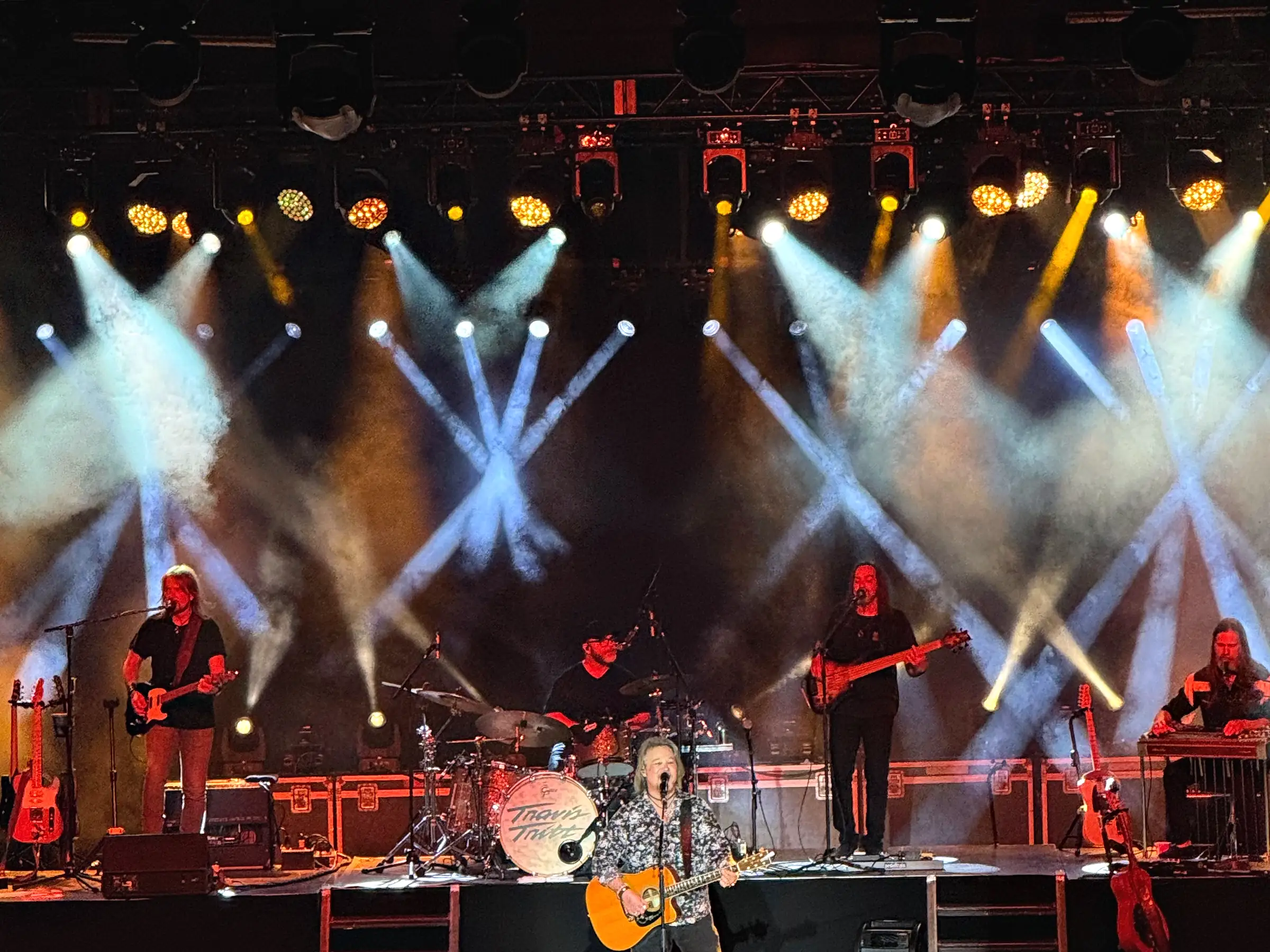
It comes from a machine, and the machine has to be sized.
With no house service, generation is the first thing on the plan and the last thing to be switched off.
- Sized off the average
A generator is sized from what the show actually draws across a day, because that is also what it burns. Sizing it off the theoretical maximum leaves a machine running all day at a fraction of its load, which is wasteful and hard on it. The maximum is a different number doing a different job — it is what the cable, the breakers and the distribution have to survive.
- Separated by what it feeds
Audio wants clean, quiet power. Lighting and LED draw in ways that audio would rather not share. Catering, offices and site lighting are a third thing entirely and they run when nothing else does. Splitting them is a design decision made early, not a matter of which machine happens to be closest.
- Where it stands
A generator is noisy and it has an exhaust, so it goes downwind and far enough away — which means long cable runs, voltage drop across them, and cable crossing ground the public walks on. Every foot of distance bought for quiet is paid for in copper.
- Fuel and runtime
The machine has to carry the whole day plus the load-in before it and the load-out after it, and refueling mid-show is not a plan. It is worked out from runtime rather than from show length.
- What happens when it stops
Redundancy is a decision taken in advance about which parts of the site cannot go dark — and the honest version names them rather than covering everything. Nothing about that decision can be made on the night.
A curfew is arithmetic, not an aspiration.
A multi-act bill has a fixed amount of time in it, and changeovers spend more of it than anybody expects.
Doors at five and a hard curfew at eleven is six hours — 360 minutes, and not a minute more, because the curfew usually belongs to a permit or an ordinance rather than to the promoter. Put five acts on it and there are four changeovers between them:
5:00 to 11:00 = 360 minutes
4 changeovers × 20 min = 80 minutes
360 − 80 = 280 minutes of music, across 5 acts
≈ 56 minutes each — before anything runs late
Twenty-two percent of the evening is spent moving equipment around. That is the number worth having before a bill is confirmed, because there are only three ways to change it: fewer acts, shorter sets, or faster changeovers — and the third one is a production decision that can actually be designed for.
What makes a changeover fast is decided weeks earlier: reading the riders early enough to know what is shared and what is not, staging that lets the next act's equipment be built offstage and rolled on, enough inputs to leave things patched rather than repatching between acts, and a crew that knows the running order. What makes it slow is discovering a requirement on the day.
Overrunning is not a scheduling embarrassment. It is a permit violation, and on a site where the curfew is written into the permission to be there at all, it is the thing that costs the promoter the site next year.
Two things that can stop the show from outside it.
The weather call
Every outdoor structure carries a rating, and a rating is only useful if somebody is watching a forecast against it, has the authority to act, and has allowed enough time to do it — lowering or clearing a structure is not instant. The threshold, the person, and what happens at it are agreed in writing before the build starts. In Florida the other half is lightning, which arrives faster than wind and clears more slowly than anybody wants it to, so the plan covers where people go as well as what gets lowered.
The wind arithmetic behind those ratings — velocity pressure, the load it puts through a given area of flat surface, and why half again the wind speed is more than twice the force — is worked through with every step shown on the LED wall page.
The property line
An outdoor show has neighbors and usually an ordinance, and the limit in it is written at the property line rather than at the mix position. That is a design input on the same footing as coverage, and the two pull against each other: the arrangement that reaches the back of the field while the least energy leaves the site is not the loudest one, it is the most directional one. How that is actually solved is on the audio page.
Permits are the third party in all of it. Structures, power, occupancy, road closures and the curfew itself each have a process with a lead time, and those lead times are usually longer than the lead time on any of the equipment.
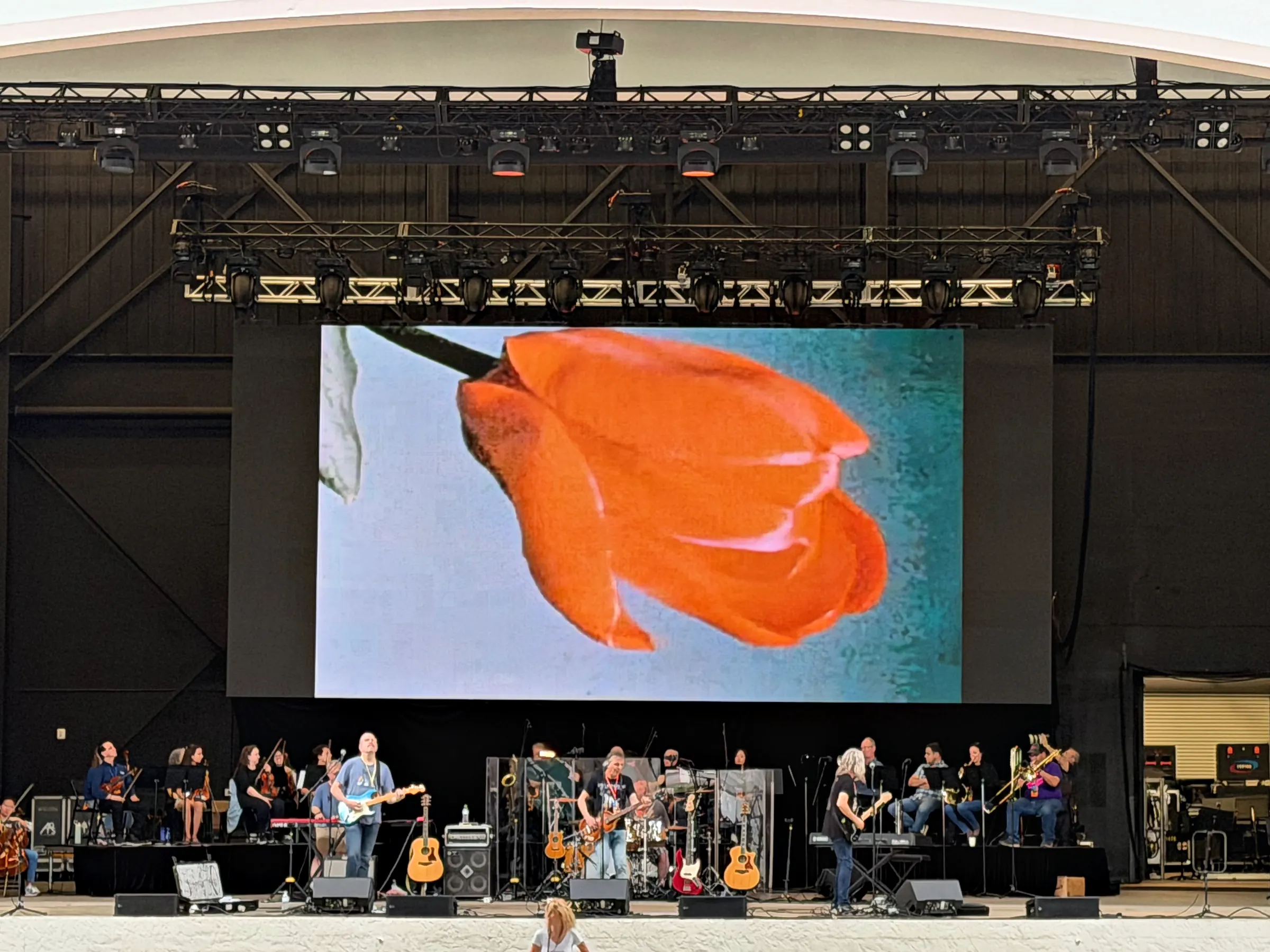
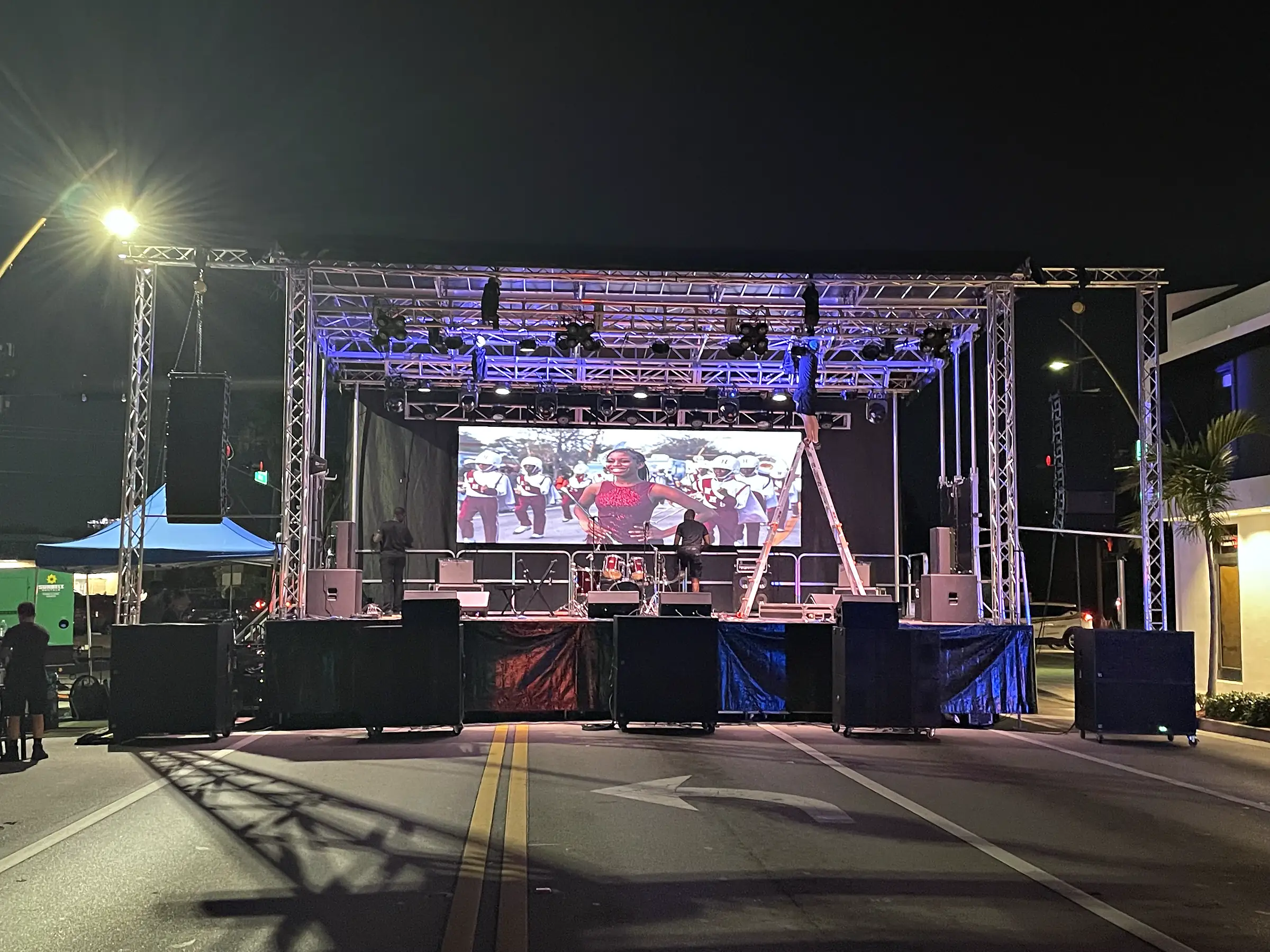
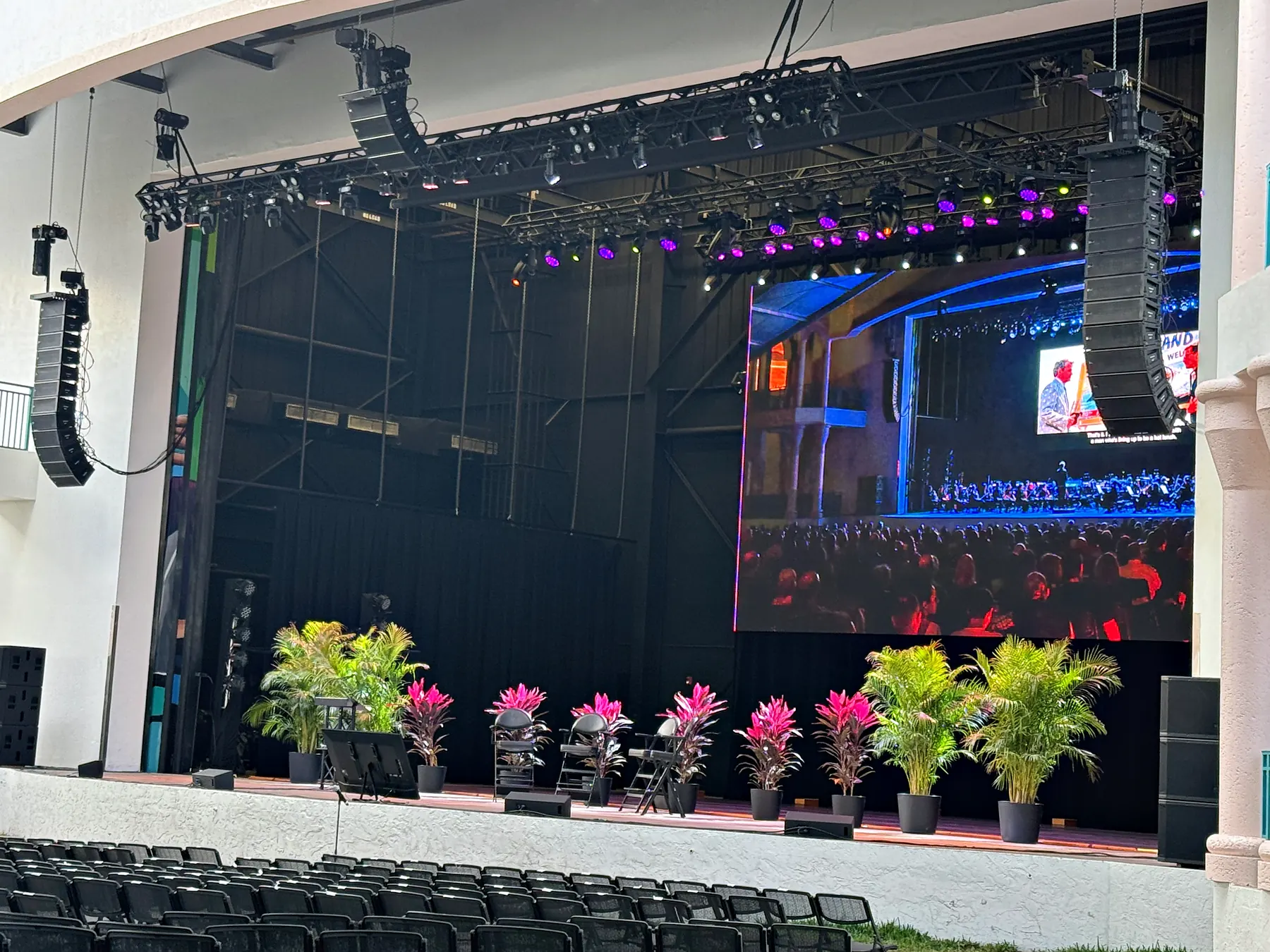
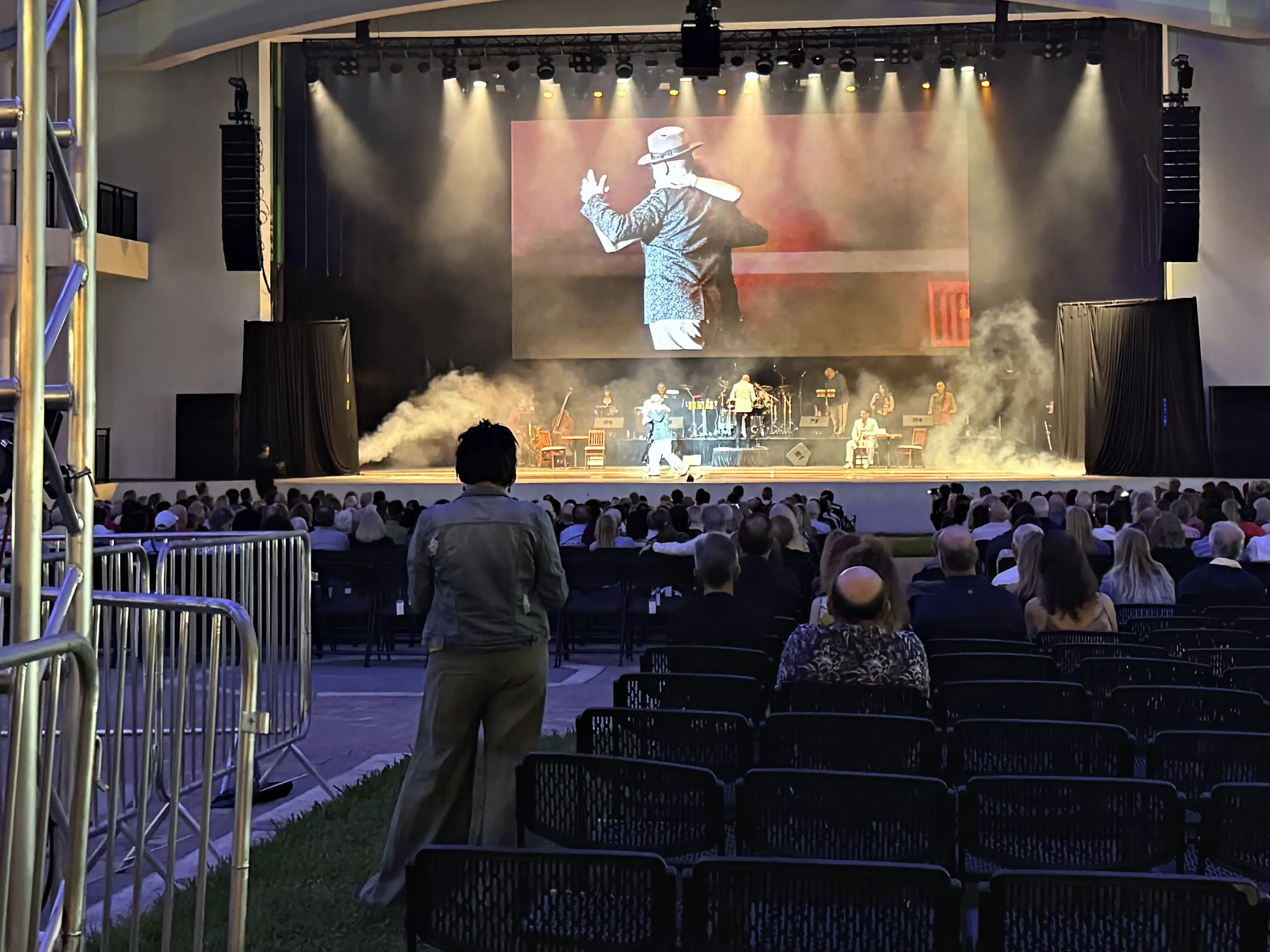
What the field does not come with, itemized.
Section 02 says each of these is a line on a plan and a person responsible for it. This is the list, in the order it goes in.
- A service, or the absence of one
Some parks and marina sites have shore power at the perimeter and some have a light pole with a convenience outlet on it, which is not the same thing and will not carry a band. Where a building is involved the tie-in point is a company switch — a protected tap a production lands on without touching the house panels. Which of the three a site has is the first question on the walk, and it is answered by looking rather than by asking.
- The copper between the machine and the show
Generation lands on feeder cable, usually through Cam-Lok single-pole connectors, and runs to distribution near the structures. That run is the thing the quiet decision in §03 is paid for in: every foot of distance bought for a generator standing downwind is a foot of copper, and the voltage at the far end is lower than the voltage at the machine.
- Three phases, and what is hung off each
Site power is three-phase, and the separation §03 describes — audio away from lighting and LED — is made at the distro by deciding what lands on which leg. A load that is heavy on one phase and light on the others is a generator working harder than its nameplate suggests.
- Protection, on wet ground
Outdoor circuits reaching catering, offices and anything the public can stand beside want GFCI protection, and a generator-derived system has its own grounding and bonding question that a building answers for you and a field does not. In Florida this is not a dry-day consideration.
- Something to hang from
Indoors there are beams and a house rigger who knows what they will take. Outdoors there is ground support: towers that carry the roof and everything under it, standing on the same ground the public walks on.
- Truss, motors, and the limit on both
Box truss is rated for a load in addition to its own weight and is only as strong as the span it is asked to cross. Chain motors lift it, and a motor's capacity is a rating rather than a permission — what is actually allowed comes off a load calculation and the working load limit of every part of the path, including the one with the lowest number.
- What the lawn does to the load path
A point load that a concrete floor ignores is a different problem on turf after two days of rain, and it is resolved with spreading and ground protection rather than with a heavier tower. This is why the ground is the first of the six answers below and not an afterthought.
- The stage itself
Decking sets the height, guardrail goes where there is an edge and a drop, and the accessible route on to it is a slope no steeper than one in twelve — which is why a two-foot stage needs about twenty-four feet of ramp before its landings are counted. That ramp is a site-plan dimension, and on a permitted event it is usually also a condition.
- Reaching the back without reaching the fence
A line array is chosen for control rather than volume, which is the directional argument §05 makes at the property line. Subwoofers are the part of it that carries furthest and is least willing to be aimed, and a delay tower covers the back of a deep field by arriving late on purpose. All three are decided against the ordinance as much as against the audience.
- Paper, which is also a line item
Tents, drapes and anything soft on a permitted site carry a flame resistance certificate, and the inspection that asks for it happens on build day rather than on show day. It is the cheapest thing on this list and the one most likely to stop a load-in.
Six answers, and the site plan follows.
None of them is about equipment, and all of them can be answered by walking the site with the permit in hand.
The ground
Grass, asphalt or deck — and what rain does to it
The gate
How a truck gets in, turns, and gets out again
Power on site
A service to tie into, or machines and fuel
The bill
How many acts, whose riders, how many changeovers
The curfew
The hard end, and whose permit it belongs to
Who is next door
Where the property line is and what is written at it
All On Stage works on concerts from local acts through national touring acts, and on multiple touring acts a year. If the show needs it, we have it. What is worth talking through first is none of that — it is the site, the bill and the curfew, because those are the three that cannot be changed once the date is set.