The site is a public place until a few hours before doors.
This single fact separates municipal work from everything that happens in a building, and it is the one most often underestimated.
A ballroom is yours from the moment it is contracted. A park, a plaza, a beach or a closed street is not. It belongs to the public until the permit says otherwise, and the permit usually says otherwise for a narrower window than anyone expects — sometimes the morning of, rarely more than a day or two before. Then it has to be handed back, clean and undamaged, on a date somebody has already published.
Everything follows from that. The build has to be fast, which means it has to be planned in far more detail than an indoor build of the same size. The strike has to be fast, which means the load-out route is designed before the load-in happens. And there is no second day to finish something, because on the second day the site is a park again.
So the production schedule is written backwards from when the site reopens, not forwards from when the trucks arrive. That is a different document from the one an indoor show runs on, and getting it right is most of the job.
Cities do not hire a vendor. They award a contract.
And then, on a published cycle, they award it again — which is the part that makes this work worth doing properly.
Public money is spent through a process, and production is no exception. Depending on the size and the jurisdiction it arrives as a quote request, a formal bid, or a term contract awarded once and drawn against for a season or several years. The paperwork is a real part of what a city is buying. A production company that cannot produce it on time is not a candidate, however good the show would have been.
- Insurance, before anything else
Certificates at the limits the solicitation specifies, with the city named as an additional insured where it asks to be, and issued far enough ahead that a correction does not cost the job. This is the most common reason an otherwise qualified bid is set aside.
- Bonds and references, where required
Larger awards carry bid or performance bonding. Both assume a company with a history and a balance sheet behind it, which is one of the reasons this end of the market has fewer participants than the private one.
- Scope written to be compared
A public bid is evaluated against other bids, so the response has to be legible line by line rather than presented as a single number. That suits a company that owns its inventory and knows what each part of the build actually takes.
- It goes back out to bid
A term contract ends and the work goes back out. Holding one is a result; holding several across several cities, through several re-bids, is a record rather than a claim.
We are under contract to numerous South Florida cities and counties, and a preferred vendor at universities and resorts. The paperwork, the insurance and the re-bidding are routine here rather than something to be figured out on your event.
The drawing is not for us. It is for the fire marshal.
A public event is approved on paper first, and the paper has to show a site people can leave in a hurry.
A special event permit is generally granted against a site plan, and the plan is read by people whose job is public safety rather than production. What they are looking for is rarely what a producer is thinking about:
- Egress
How the crowd leaves, from every part of the site, when something has gone wrong. Exit routes and their widths are a function of how many people are expected, and they are the first thing that gets checked against the layout somebody has already designed around a stage position.
- Emergency vehicle access
Lanes that stay clear, wide enough and continuous, from the street to the parts of the site people will be standing in. Barricade lines, vendor rows and cable paths all have to respect them, and a lane that exists on the drawing but is blocked by a truck on the day is a failed inspection.
- Tents, structures and their anchoring
Anything covered is usually its own permit with its own documentation, and how it is held down is part of it — staked into ground that will take a stake, or ballasted where it will not.
- Accessible routes and viewing
A public event has to be usable by the whole public. That means a firm, continuous accessible route across ground that may be grass or sand, accessible viewing with a real sight line rather than a marked square behind a crowd, and ramps wherever a riser or a stage is something a person is expected to get onto.
- An inspection before doors
The build is generally walked and signed off while there is still time to fix something. That inspection is a milestone on the production schedule, not an afterthought at the end of it, and everything upstream is planned to be finished before it — which usually means finished earlier than an indoor build of the same size would need to be.
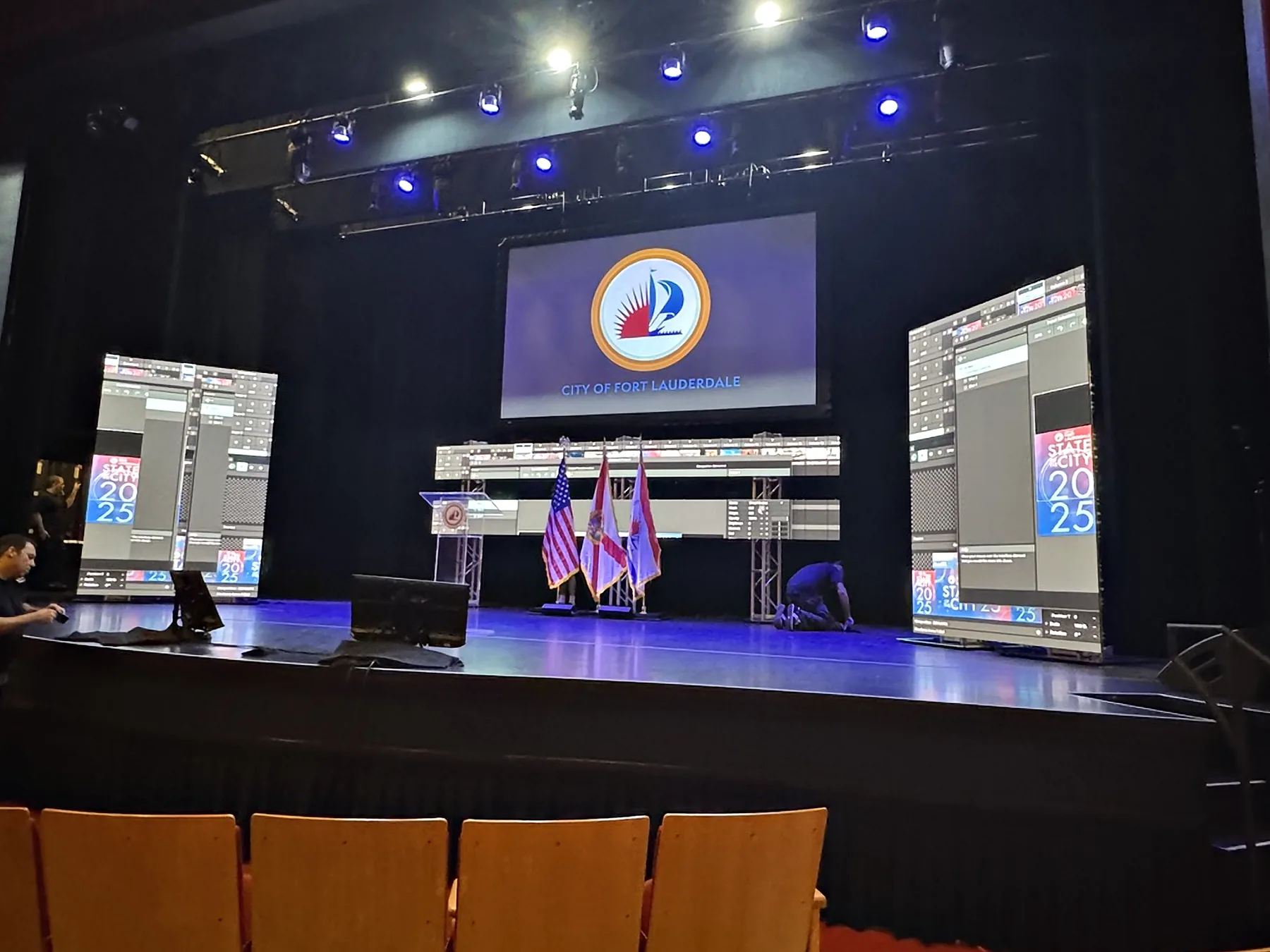
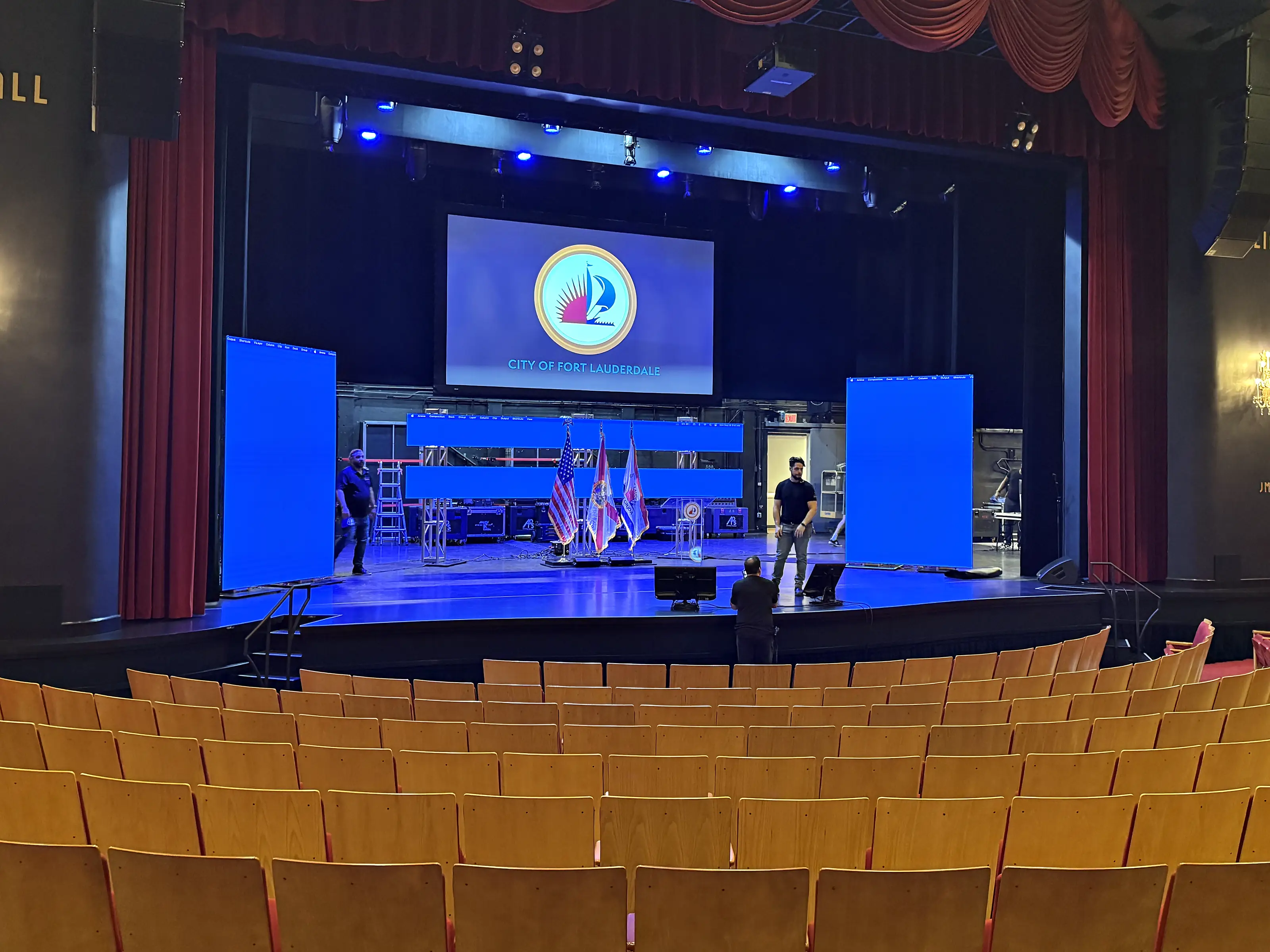
There is no house power. There is no house anything.
A park has lighting for a park. What a stage needs arrives on a truck, and where it is parked changes the design.
Indoors, the building has a service and the question is how to reach it. On a public site there is usually nothing usable at all, so the supply is generated, and the generator has to sit somewhere a truck can reach, somewhere the noise does not land on the audience, and somewhere the fuel can be managed safely. Those three constraints rarely point at the same patch of ground, and none of them points at the spot closest to the stage.
Which makes distance an electrical problem. Voltage falls along a cable run, and the further the generator is parked from the distribution, the more of the supply is lost on the way. The usual design target is to keep that loss to about 3% on a feeder. For a 250-foot run carrying 200 amps on 4/0 copper, three-phase:
1.732 × 12.9 × 200 A × 250 ft ÷ 211,600 cmil = 5.3 V
5.3 V ÷ 208 V = 0.025
≈ 2.5% drop — inside the target, with little room to spare
Double the distance and the loss doubles with it. Work it out in advance, rather than discovering it when equipment misbehaves at the far end of a long site. The answer is sometimes a larger conductor, sometimes a generator parked closer, sometimes a second distribution point — but it is always a decision made on the site plan, not on the day.
We carry distribution in all sizes and connector types, on Soco, and generators from 6kw to 80kw. Which one a site needs comes out of the total load, the distance, and what else is sharing the source — food vendors in particular, who arrive with their own draw and frequently without having been asked about it.
One more thing that only happens outdoors: every cable that crosses somewhere a person will walk has to be ramped or matted, and every ramp is an accessible route question as well as a trip hazard one. Cable path is part of the site plan for the same reason the fire lane is.
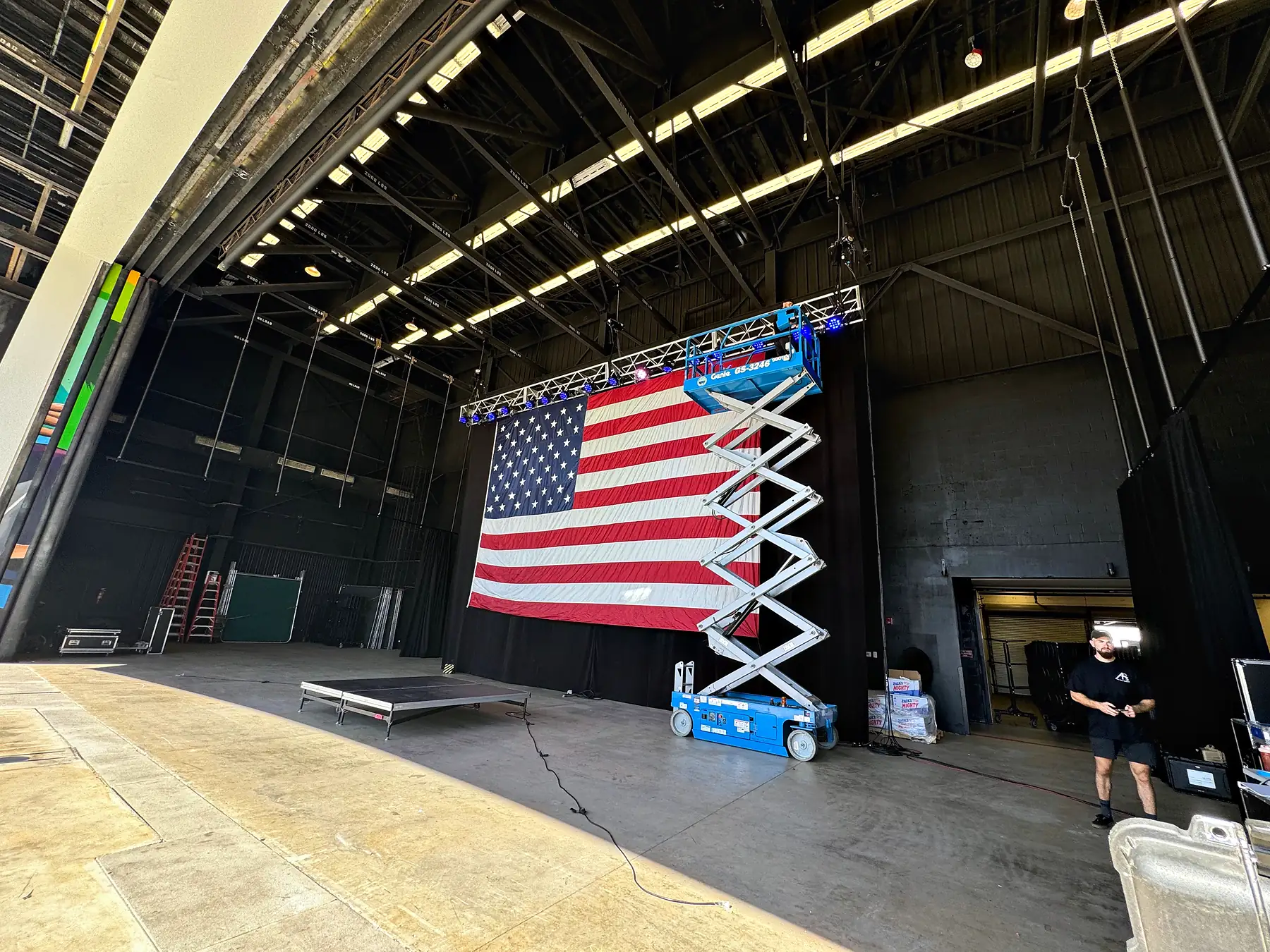
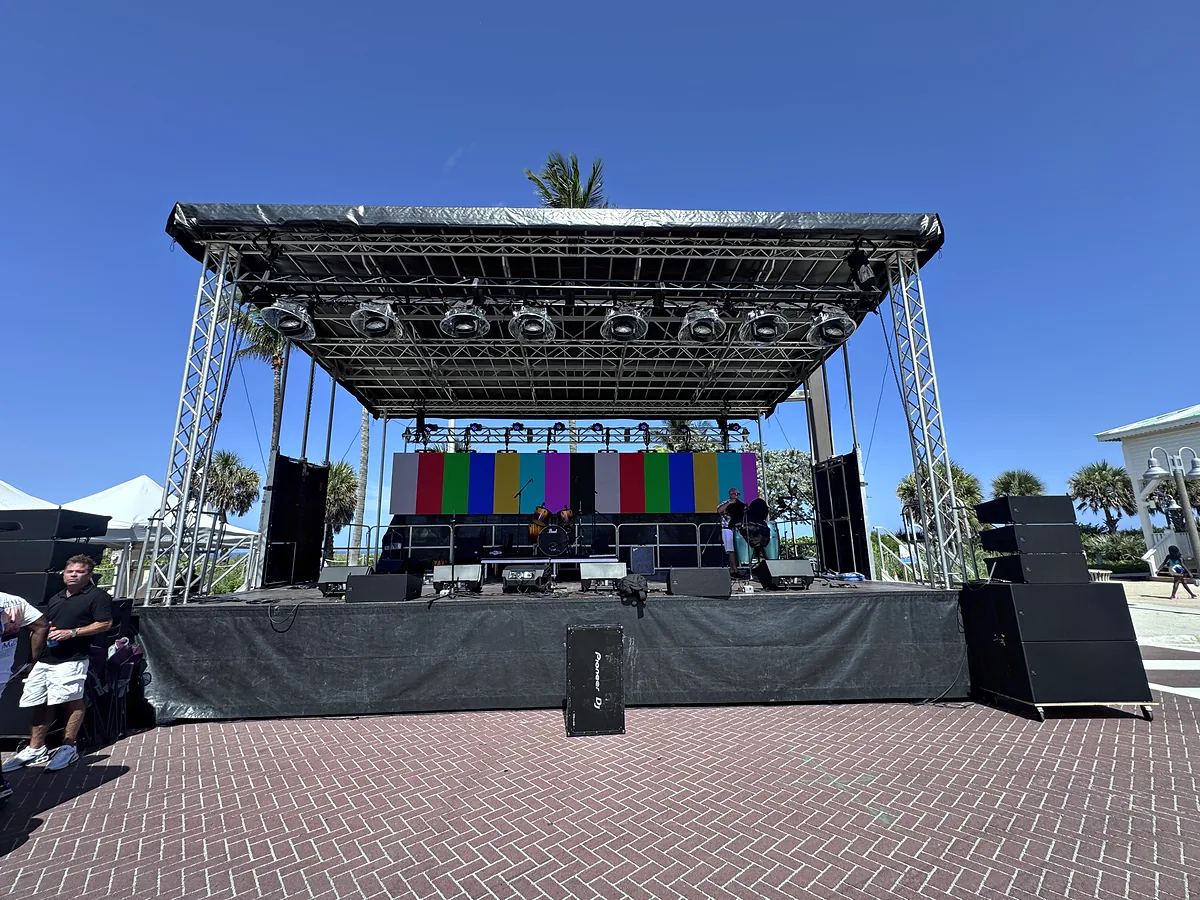
What the stage stands on decides what the stage is.
This is the driver most often missed at the point where a budget is being put together, and it is usually the largest one.
A mobile stage is a trailer. It drives in, deploys, and it is a stage — fast, predictable, and with most of the labor built into the vehicle. It is very often the right answer on a municipal site, and where it is, it is hard to beat.
But it has to physically get there. A gate too narrow, a turning circle too tight, ground too soft to carry a loaded trailer, a slope, a buried utility, a tree line, a plaza reachable only by steps — any one of them and the trailer is not an option, whatever the drawing says.
A stage that has to be custom-built because a mobile stage cannot reach the site will almost always cost more. It is built by hand, from parts, in the time the permit window allows, which is labor rather than equipment — and on soft ground it frequently brings ground protection with it, because decking and towers have to bear on something that will not sink and the turf has to be handed back in the condition it was found.
None of which is a reason to avoid a difficult site. It is a reason to establish access early, because the answer to "can a trailer get in here" moves the number more than almost anything else on the estimate, and it is knowable weeks before anything is quoted.
Six answers, and the rest is arithmetic.
Not one of these is a question about equipment. Each one changes the build, which is why they come first.
The permit window
When the site becomes yours, and when it has to be a park again
Vehicle access
What can physically reach the stage position — the §05 question
The ground
Grass, sand, asphalt or deck, and what it will carry
Expected attendance
Egress widths and accessible provision are set from it
The ordinance
The sound limit and the curfew, measured at the property line
Weather contingency
What comes down, who decides, and at what point
If the show needs it, we have it. On a municipal site that matters more than usual, because the schedule has no slack in it: a part that has to be sourced on the morning of the build is a part that arrives after the inspection. What is worth talking through early is the site, the access, the window and the ordinance — the four things that cannot be changed later.
Where the figures come from
- Voltage drop — 1.732 × K × I × L ÷ cmil — the standard approximation for a three-phase feeder — 1.732 is the square root of three — with K taken as 12.9 for copper and 4/0 as 211,600 circular mils. The 3% figure is the usual design target for a feeder rather than a code requirement, and the arithmetic in §04 is computed from those values on the page.
- Contracted and preferred production vendor, numerous municipalities — contracted and preferred-vendor relationships held by All On Stage Productions. The counts are published and the names are not, deliberately and permanently.