Contracted and preferred production vendor
Corporations, promoters, and numerous municipalities, counties, universities and hotels.
They choose us to execute at the highest level, every time.
The rehearsal is longer than the show.
This is the single most underestimated number in corporate production, and it is arithmetic rather than opinion.
Take a ninety-minute general session with fourteen people going on stage — a chief executive, a few executives, an award or two, a customer, a video package. Rehearsing it properly means every one of them walks on, finds their light, hears themselves, gets their content on the screen and walks off:
14 presenters × 8 min of stage time = 112 min
13 transitions × 3 min = 39 min
112 + 39
≈ 151 min — for a 90-minute session
Two and a half hours to rehearse an hour and a half. Booked as a one-hour rehearsal, what actually happens is that the first four presenters are rehearsed and the other ten find out where the stairs are during the show. The fix costs nothing but a room and a calendar entry, and it has to be made weeks earlier, because by the time it is obvious the room is booked for something else.
What rehearsal is really for
- The content, not the people. Most of what goes wrong on a general session is a deck: the wrong aspect ratio, a build that does not build, a video with no audio path, a font that is not on the machine. Every one of those is a five-minute fix in rehearsal and a visible failure in the session.
- The handoffs. Who is holding the microphone, who is advancing the slides, where the presenter stands so they are lit and not in the projection, and what happens in the four seconds between two people.
- Confidence. A presenter who has stood on the stage once already, in the light, hearing themselves, is a different presenter. That is the part the audience notices and nobody can attribute.
Presentation management is the discipline that sits under all of it — decks collected, checked, versioned and driven from one machine by somebody whose entire job that is, rather than from a laptop on the lectern with a notification turned on.
The room is doing other business.
A hotel ballroom is not an empty box waiting for you. It has a commercial calendar, and the production schedule is fitted into it.
- The load-in window
When the room is released, and to whom, is the constraint the whole build is planned backwards from. A room that comes free at ten at night for a nine o'clock start is a different production from the same room available from noon the day before — same equipment, different crew size, different sequence, different risk.
- The sequence is fixed
Rigging goes in before anything hangs from it; power is in and tested before anything is plugged in; scenic goes up before the floor is dressed; focus needs an empty room. Those dependencies cannot be parallelized by adding people, which is why "can we start later and use more crew" usually has one answer.
- Doors, docks and elevators
Freight access, elevator dimensions, the route from the dock to the room and what else is using it are the difference between a four-hour load-in and an eight-hour one. They are published or walkable in advance, and they are rarely asked about until the week of.
- What the ceiling gives
Clear height and hang points decide what can be flown and what has to stand on the floor, which decides sightlines and floor area. Fourteen feet of clear height rules things out rather than making them harder — and that is a fact about the room, known long before anyone designs against it.
- Who else is in the building
Another event next door shares your dock, your elevator, your electrical service and your radio spectrum. It also shares your wall, which is a sound problem in both directions and one the room's own air walls rarely solve on their own.
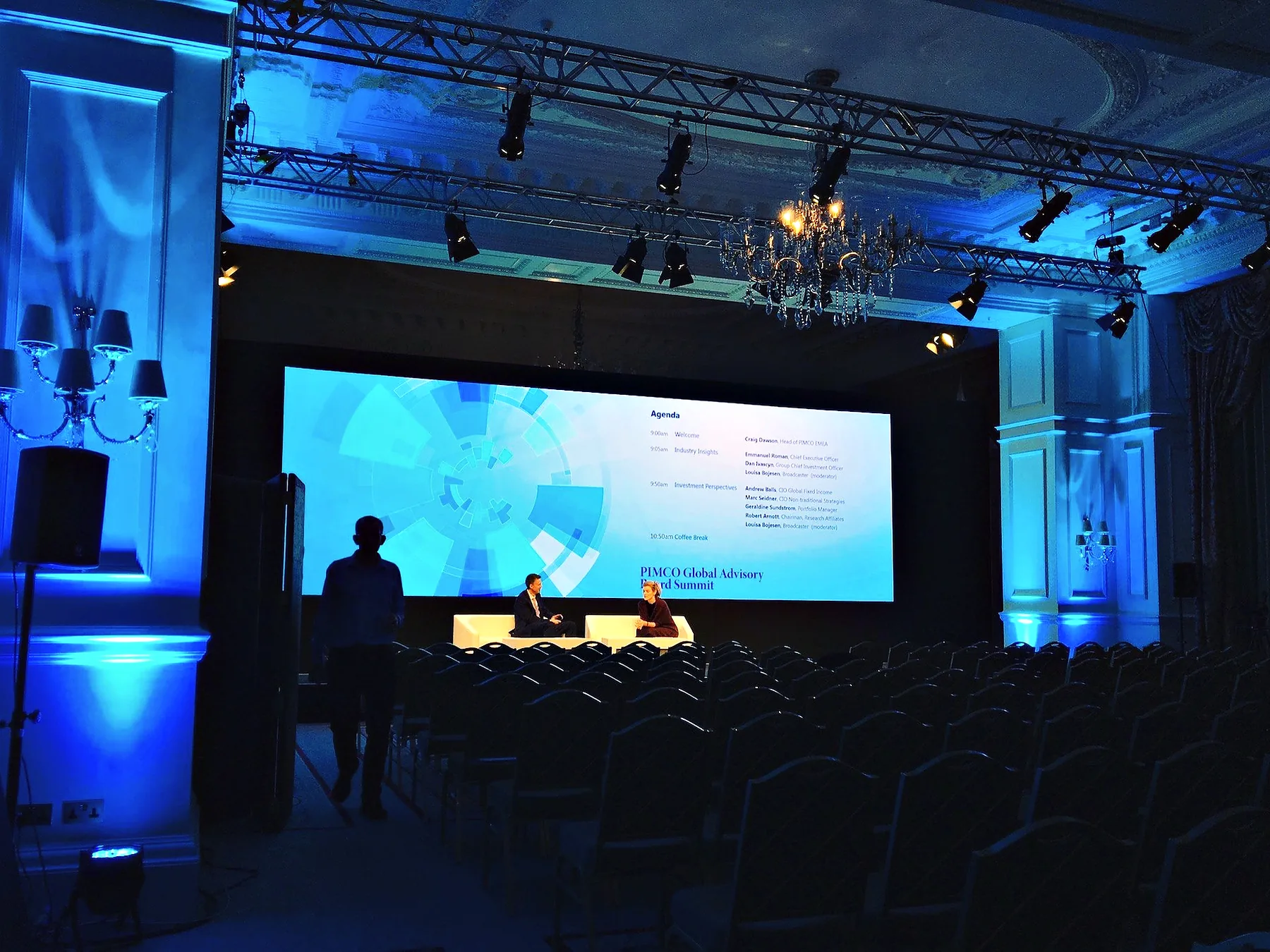
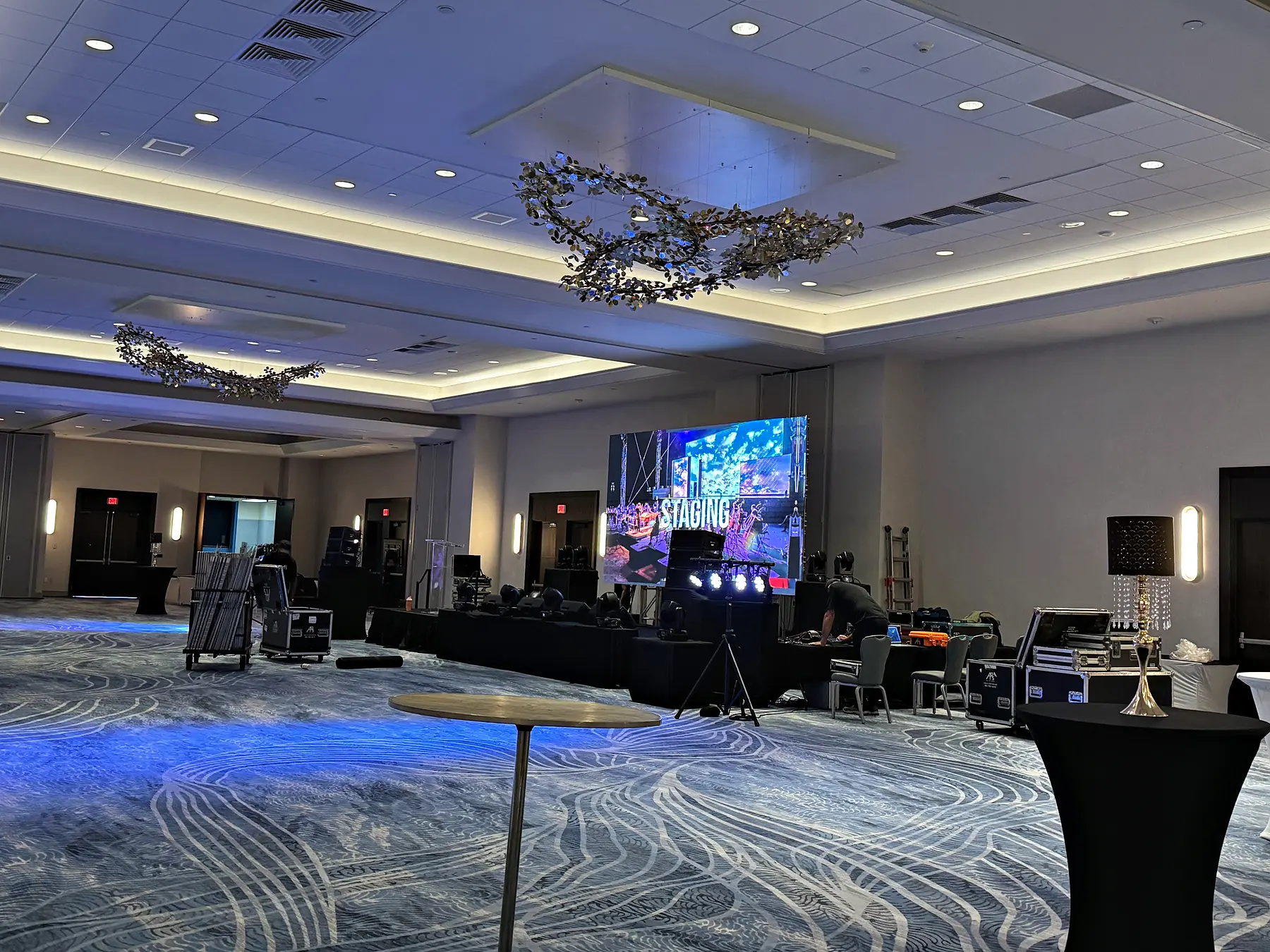
A general session is one room. A conference is twelve.
The general session gets the attention because it is the biggest room and the one the executives are in. The breakouts are where a conference is actually judged, because that is where most of the audience spends most of the day — and they are a different problem. Twelve rooms means twelve of everything small, twelve sets of content, twelve people who need to be shown how the microphone works, and a turnaround between sessions measured in minutes.
What makes that work is standardization and a crew large enough that somebody is in each room when it matters. What breaks it is treating the breakouts as leftovers from the main room — the general session gets three rehearsals and the breakouts get a wave from the door.
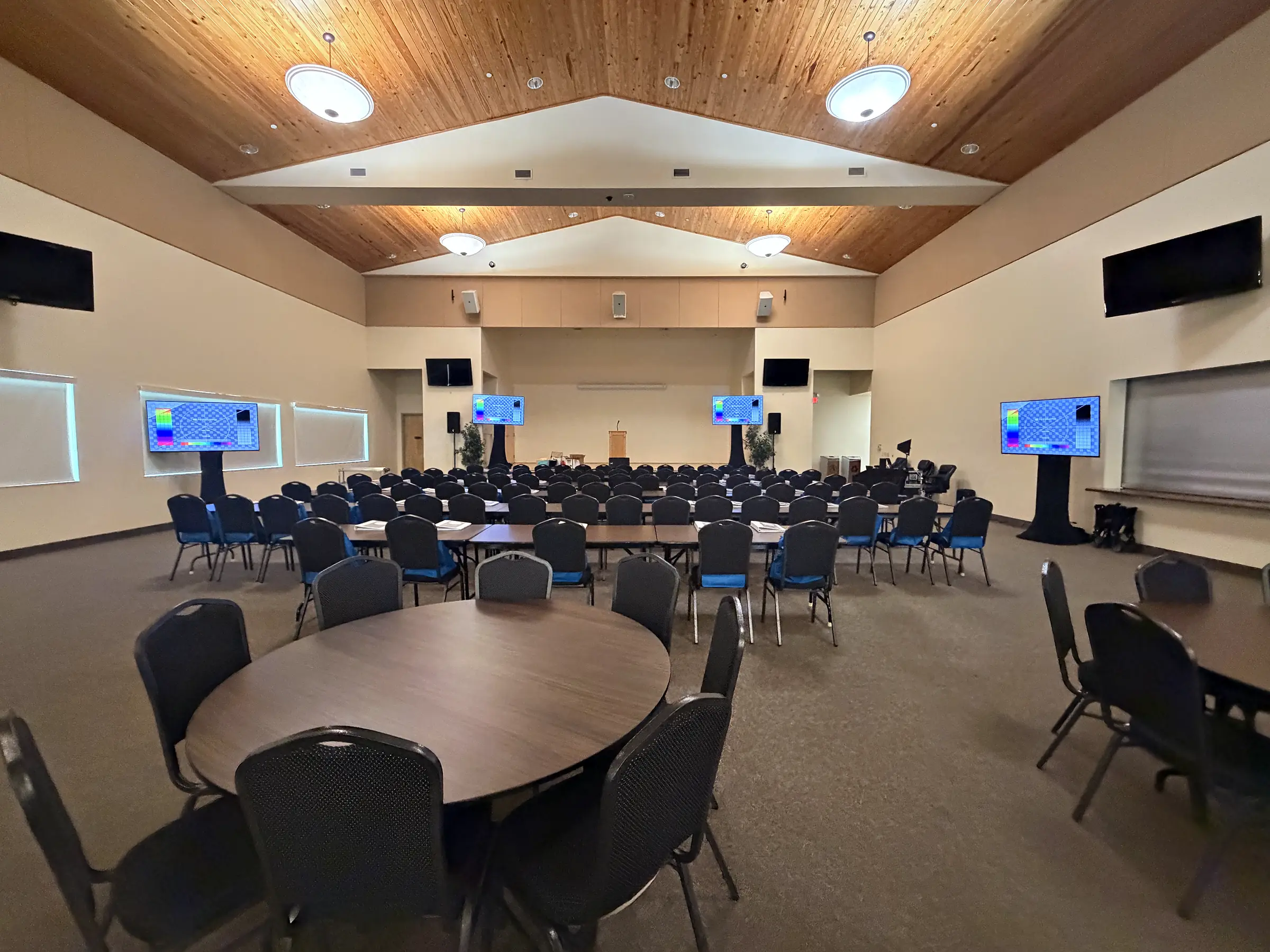
A conference room on its own is a job too, and a common one. A board room, a training room, a hotel meeting room set with rounds — screens, a microphone or two, a lectern, something to plug a laptop into, and somebody there to make sure it works before the room fills. One room or a whole floor of them, we set them up and we run them.
The same logic scales down. A single company meeting, a launch, a ribbon cutting on the building being opened, an awards night, a party on a lawn — each is one room with one hour that matters, and the production question is identical: what has to happen in it, and what does that require to be in place beforehand. Several of those are not ballrooms at all, and the outdoor ones pull tenting, staging, show power and flooring onto the same plan as the audio and video.
The stream is a second show.
An audience in the room and an audience on a link are not the same audience served twice. The people in the room have context — they can see the whole stage, they know who just spoke, they can read the room. A remote viewer has a rectangle and whatever is in it, and everything outside the frame may as well not exist.
That changes decisions upstream. Lighting has to expose a face for a sensor rather than for an adapted eye. Content has to be legible at the size it is actually watched at, which is often a laptop on somebody's lap. Every microphone that matters has to be in the program mix, including the question from the floor that the room can hear and the stream cannot. And the upload is infrastructure like any other: venue internet is shared with everyone else in the building, so a stream that matters gets a path of its own and something behind it.
A recording is a third audience again, watched later, by people deciding whether to attend next year. It costs almost nothing extra on the day if it is planned in, and it cannot be created afterwards.
Where the shop is, and where the work goes.
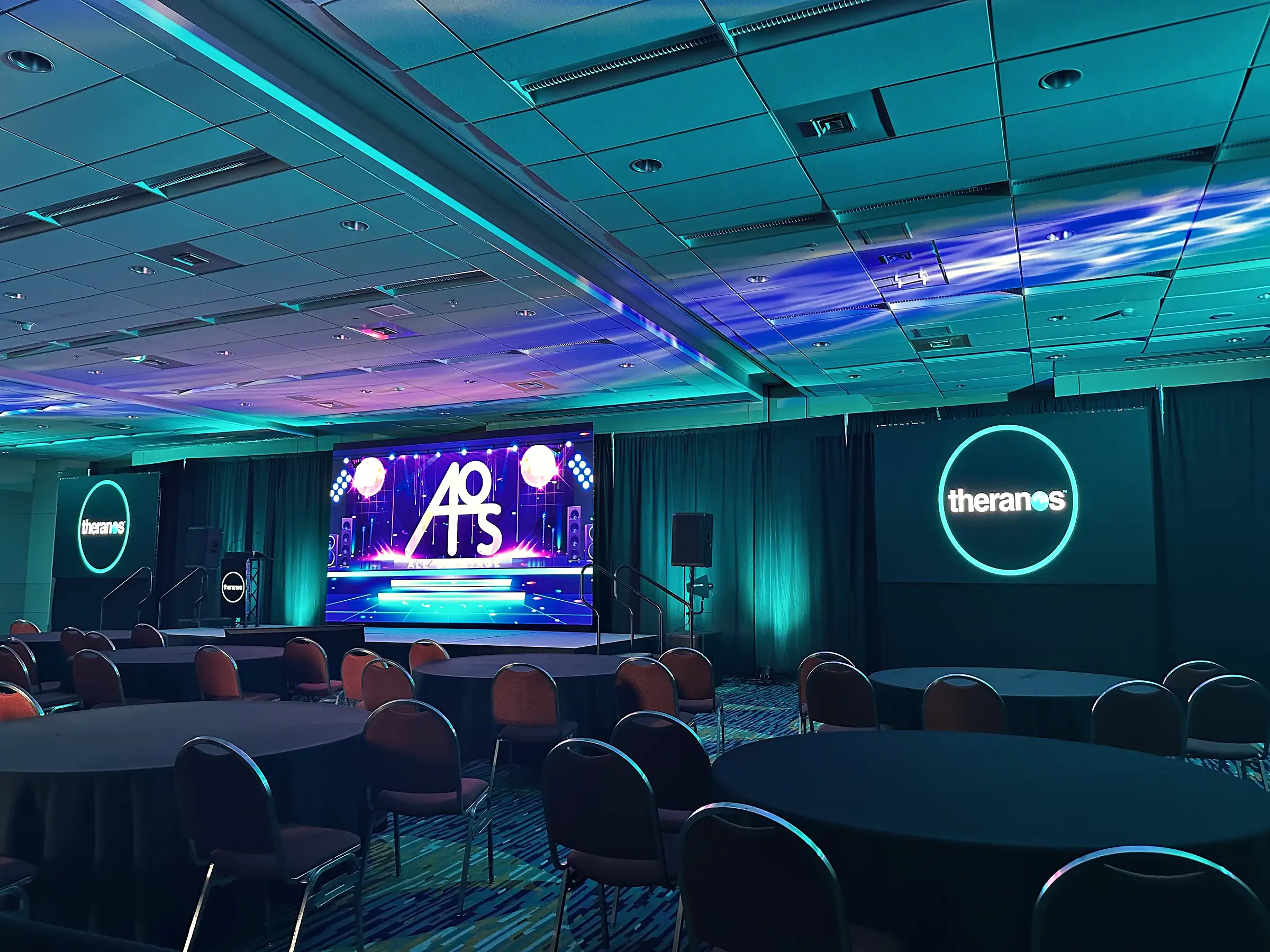
The shop and the trucks are in Pompano Beach, and South Florida is where most of the work is. We travel out of state, and we work in New York.
We are a contracted and preferred production vendor for corporations, promoters, universities, hotels, and numerous municipalities and counties.
The other thing worth knowing is what else the same crew does. All On Stage is a full production company across every event type — concerts from local acts through national touring acts, outdoor festivals, and municipal and civic events, as well as corporate. A general session run by people who also load in a festival on a field is a general session where the schedule, the power and the contingency are taken seriously, because on the other jobs there is nowhere to hide. If the show needs it, we have it.
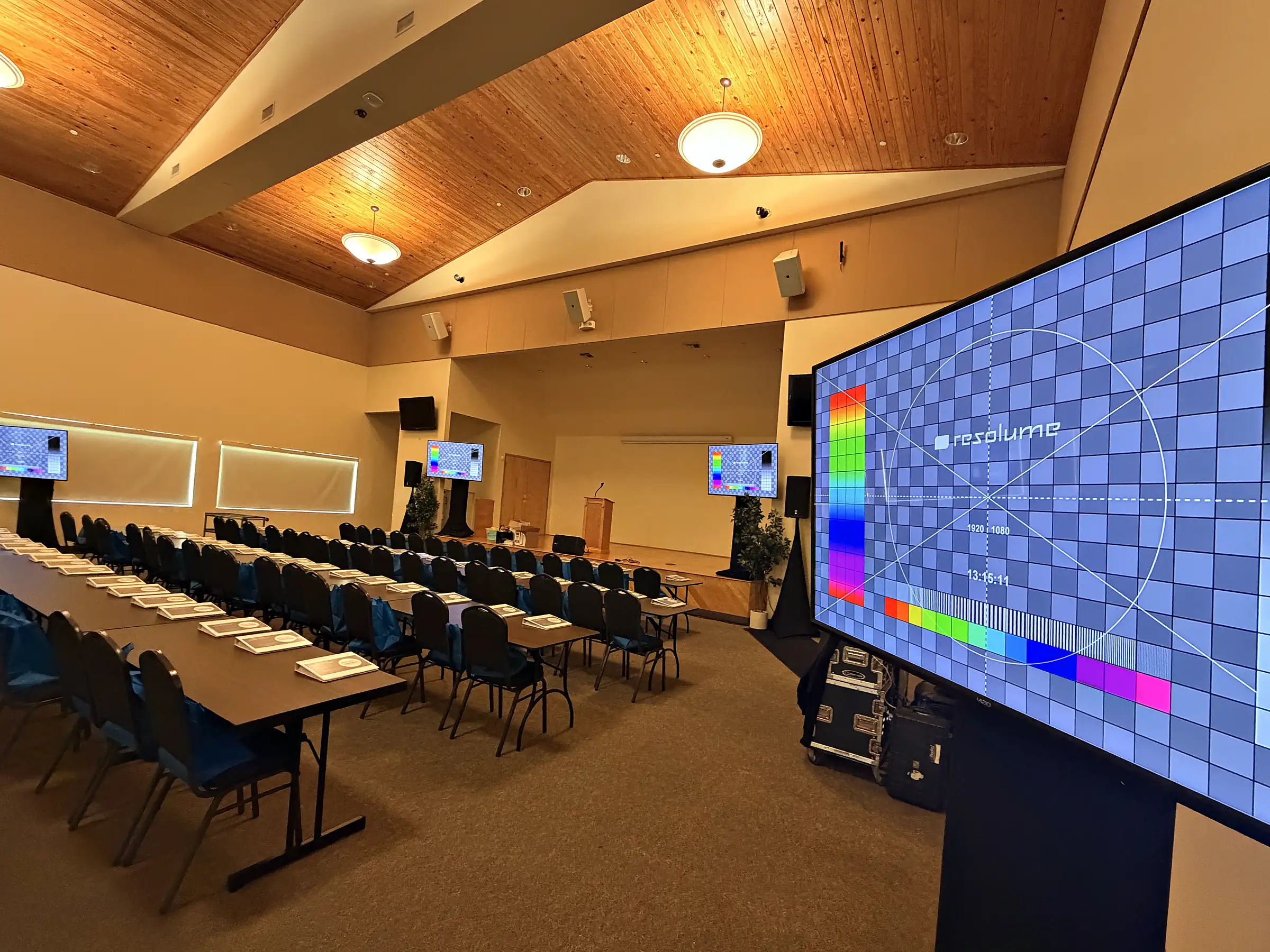
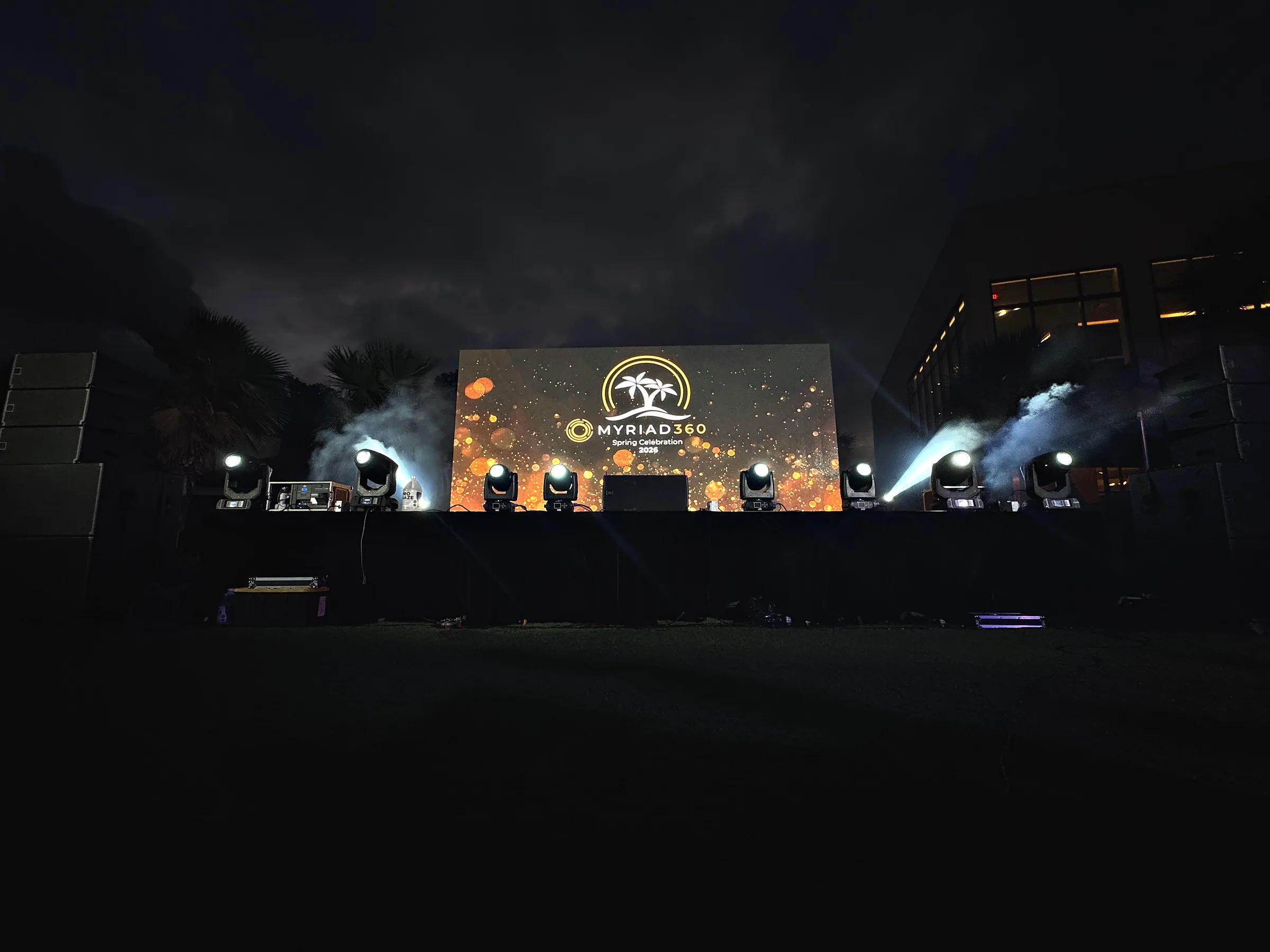
What the ballroom does not come with.
Section 02 says the room is doing other business. This is what gets carried into it, named as types rather than as models.
- What the presenter wears, or holds
A lavalier microphone disappears on camera and is the usual answer for a seated panel. A headset microphone holds a fixed distance from the mouth, which is what a presenter who moves needs. A wireless microphone in a hand is the third, and the lectern in §01 usually has one of its own that nobody has tested. Which one a person gets is a rehearsal decision, because it changes how they stand.
- The spectrum the building is sharing
Every one of those is a radio, and the event next door in §02 is running its own. Frequency coordination is the work of assigning each transmitter a channel that will not collide with the others or with the local television allocation. It is done on paper before the day and confirmed with a scanner in the room — and two productions that coordinated separately have not coordinated.
- Getting a laptop into the system
The video package in §01 has an audio path, and it is usually a headphone socket on a machine sixty feet from the loudspeakers. A DI box converts that to something that travels the length of a ballroom without collecting the room on the way. Gain structure — the level set at every stage from the source to the amplifier — is why one deck plays loud and the next is inaudible, and it is set in rehearsal or not at all.
- Hearing themselves
§01 says a presenter who has heard themselves is a different presenter. That comes from a monitor wedge on the deck or from in-ear monitors, and in a ballroom the choice is mostly about what the room does with the sound that misses. A wedge pointed at a presenter is also pointed at the first three rows.
- The shape of the stage
A proscenium arrangement puts the audience on one side and gives everything that is not the show somewhere to stand. A thrust stage pushes into the room, which buys intimacy and costs sightlines and lighting angles in both directions. Stage directions are given from the performer looking out rather than the audience looking in, and that is the most common misunderstanding in a rehearsal room.
- Covering what is not the show
Most of a ballroom is not meant to be looked at. Pipe and drape is the fast answer — uprights, a crossbar and fabric — and masking is the principle it serves: putting a surface between the audience and the cases, the cable and the people who are not on.
- Something behind the presenter
A flat key with nothing behind the presenter puts them against their own shadow on the backdrop, and what that backdrop is matters. A scenic flat is built and rigid and takes a hard edge. A scrim is an open weave that reads solid lit from the front and transparent lit from behind, which is how a reveal is done. A cyclorama is a seamless surface meant to be lit as a colour rather than looked at as an object.
- Washing the room itself
Uplighting is fixtures on the floor aimed up the walls and columns, and it is the largest change to how a ballroom reads when the doors open. On camera it is also several more sources at a colour temperature nobody chose, which is the mixed-source problem the lighting guide works through in full.
- An awards night has two more
A step and repeat is the branded wall people are photographed against on the way in, and it wants its own light and clear floor in front of it rather than a corner by the doors. A dance floor is a structural and a scheduling item rather than a decorative one: it goes in around dinner service, and where it lands decides where the audio cannot be.
- What is actually holding the truss
§02 asks what the ceiling gives. A dead hang is a fixed-length attachment with no motor in it to move the load afterwards, which is what most ballrooms allow. The connection is made with a shackle and often a span set round the steel, and every part of that path carries a rating of its own. The lowest number in the path is the number that counts, and it is rarely the one quoted.
- Power, in a room that is already wired
A ballroom has outlets, and they are on the house circuits with the kitchen. Production power arrives separately: Socapex carries six circuits in one multi-pin cable, so a truss takes one run rather than six, and it breaks out to stage pin connectors at the fixture. Across a carpeted floor in a building doing other business, that is a trip-hazard decision as much as an electrical one.
Six answers, and we can scope it.
None of them is a budget question. Each one changes the specification, which is why they come first.
The date and the room
And when the room is actually released to you
Who goes on stage
How many, and how long you have to rehearse them
How many people
Roughly, and how they are seated
Clear height
And what the venue publishes for hang points
Breakouts
How many rooms after the main one, and the turnaround
Who is watching
Streamed, recorded, or the room only
If the date is soft or the room is still a maybe, that is the conversation rather than a reason to put it off. Most of the above can be answered with "not yet", and the ones that cannot are the ones worth a phone call.