Arts festival · Video · Audio · Lighting · Backline · Streaming
An orchestra playing a film score live, to the film
A conductor cueing an ensemble to a picture is working to a deadline measured in single frames. At 24 frames a second one frame is 41.7 milliseconds — and sound covers 47 feet in that time, which is wider than the orchestra playing it.
What we can actually tell you.
Arts festival. A large video wall showing a film, the soundtrack played live by an orchestra. Lighting, sound, backline and streaming.
- What it was
- An arts festival
- The picture
- A film on a large video wall
- The score
- Played live by an orchestra
- Also ours
- Lighting, sound, backline and streaming
That is the whole of what is claimed about this job. Everything below is either craft that is true of the work in general or arithmetic worked here from figures cited on this page.
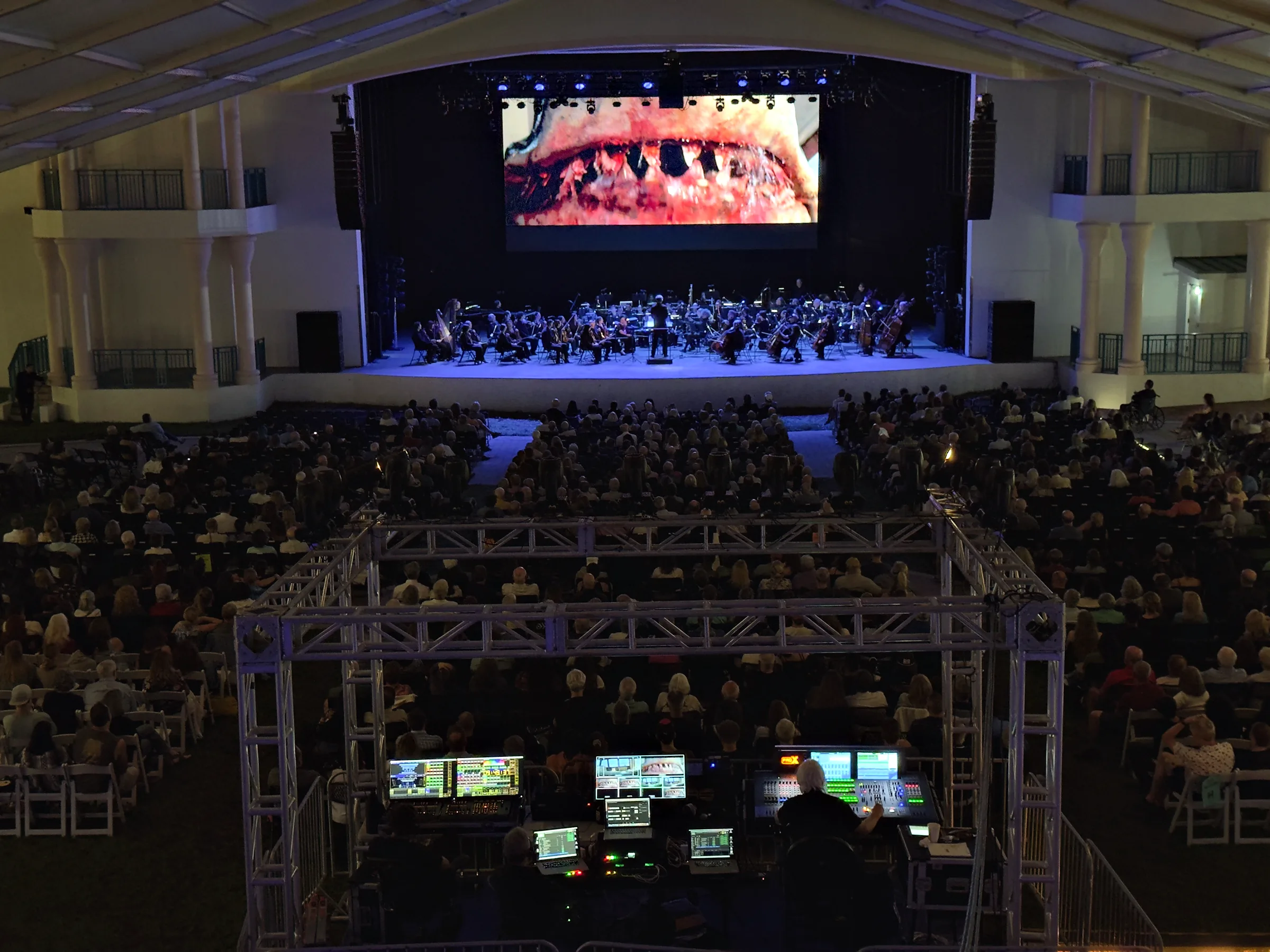
Normally the picture follows the score. Here the score follows the picture.
That inversion is the entire technical brief, and everything else on this page falls out of it.
In almost every show that carries both, the video department is chasing the audio: a playback roll is triggered off a cue, a camera cuts to whoever is speaking, and if the picture arrives a frame late nobody in the room can tell. The picture is downstream, and downstream is a forgiving place to be.
Put a fixed piece of film on the wall and a live ensemble under it and the direction reverses. The film does not wait. It runs at its own rate from the first frame to the last, and the conductor — who cannot see the wall, because they are facing the other way — has to hold sixty or eighty players against a clock they are not looking at. The picture has become the metronome, and a metronome that is wrong is worse than no metronome at all.
So the question that decides the rig is not how big the wall is or how loud the room gets. It is: what exactly is the conductor looking at, how far behind the wall is it, and does that number stay the same for the whole runtime. Answer those three and the show works. Leave any of them to chance and the ensemble drifts, in front of an audience that knows this music well enough to have bought a ticket to hear it played to the film.
One frame of delay is 47 feet of air.
Two published constants and a division. Frame time comes from the frame rate; the conversion to distance comes from the speed of sound, which is the unit musicians already think in whether they know it or not.
Frame time by rate, and the distance sound covers in it
| Frame rate | One frame | Sound travels | Two frames |
|---|---|---|---|
| 24 fps (film) | 41.7 ms | 47 ft | 94 ft |
| 25 fps | 40.0 ms | 45 ft | 90 ft |
| 30 fps | 33.3 ms | 37 ft | 75 ft |
| 60 fps | 16.7 ms | 19 ft | 38 ft |
Frame time is 1,000 ÷ the frame rate: 1,000 ÷ 24 = 41.7 milliseconds. Distance is that time × 1,125 feet per second, the speed of sound in air at about 68 °F: 0.0417 × 1,125 = 46.9 feet. The right-hand column is there because two frames is what a modest processing chain costs — a scaler and a receiving card, one frame each, is an ordinary rather than a careless build.
The distance column is the one that makes this concrete for anybody who plays. An ensemble already runs on acoustic delay: a player thirty feet across the stage is heard 27 milliseconds late, and holding an ensemble together across that spread is most of what a conductor is for. It is a familiar, bounded problem, and the bound is the physical size of the group.
Two frames of video processing at 24 frames a second is 94 feet of that same delay — three times the width of the ensemble, arriving from the one source in the room that cannot be listened to and cannot be argued with. It is outside the range the conductor has spent a career compensating for, and it is silent, so nothing about it announces itself. The ensemble simply sits behind the film, and keeps sitting behind it.
Which is why the conductor's feed is specified before the wall is. A monitor in the conductor's eyeline, fed from as close to the playback source as the chain allows, and measured rather than assumed — because "it looks fine" is a judgment made by somebody standing still, and the error this is protecting against is one that only shows up over four minutes of music.
Where these figures come from
- Frame time is arithmetic: 1,000 ms ÷ the frame rate. 1,000 ÷ 24 = 41.67 ms; ÷ 25 = 40.0; ÷ 30 = 33.33; ÷ 60 = 16.67.
- The speed of sound in air at about 68 °F is roughly 1,125 feet per second (343 m/s). Distance = frame time × 1,125.
24 frames into a 60 Hz chain is not 24 frames.
A constant delay can be measured once and dialled out. An inconsistent one cannot, and this is the ordinary way a chain produces one without anybody choosing it.
Film runs at 24 frames a second. A great deal of video infrastructure runs at 60 hertz. Sixty does not divide by twenty-four, so something has to give, and what gives is the duration each frame is held for: in the standard pattern, frames alternate between being held for two sixtieths and three sixtieths of a second.
Two sixtieths is 33.3 milliseconds. Three sixtieths is 50 milliseconds. The nominal is 41.7. So every frame lands 8.3 milliseconds early or 8.3 milliseconds late, forever, in a repeating cadence — and 8.3 milliseconds is 9 feet of air by the same conversion as the table above. The picture is breathing back and forth across nine feet while the conductor tries to sit on it.
It is not a large error and it is not a fatal one. It is an avoidable one, which is the point: run the whole chain at 24, or at 48, or at 120, all of which divide by 24 exactly, and every frame is held for the same length of time. The decision costs nothing at the planning stage and cannot be made at all once the rig is in the air, because it is a property of the chain rather than a setting on a box.
What a 24 fps frame is held for, inside a 60 Hz chain
| Held for | Duration | Against a 41.7 ms nominal | In feet of air |
|---|---|---|---|
| 2 sixtieths | 33.3 ms | 8.3 ms early | 9 ft |
| 3 sixtieths | 50.0 ms | 8.3 ms late | 9 ft |
One sixtieth of a second is 16.67 ms, so two is 33.3 and three is 50.0. The pattern averages to the correct 41.7 ms over each pair, which is why the film still finishes on time and why the error is easy to miss: it is jitter around a correct mean rather than drift away from one.
One second of stream latency is twenty-four frames.
Streaming and monitoring are two different jobs done by two different paths, and the failure is conflating them.
Segmented internet streaming is reliable because it buffers. The encoder cuts the show into segments, the player holds several of them before it starts, and that buffer is what absorbs a dropped packet on somebody's home connection instead of turning it into a stall. The latency is not a defect in the design; it is the design.
Which puts an encoded stream seconds behind the room, and a second is twenty-four frames — 1,125 feet of air by the same conversion, a fifth of a mile. Nothing on stage can be cued from it. The distinction matters because the two feeds look identical on a screen and because the stream is often the one that is easiest to get to: it is already encoded, already distributed, and there is already a monitor showing it somewhere in the building.
So the conductor's picture comes off a direct, low-latency path with as little between it and the playback source as the design allows, and the stream is treated as an output rather than a reference — something the show feeds, never something the show follows. Anything that has to come back into the room from the stream side is designed for separately, with its own latency budget, and is never in a performer's eyeline.
A large lit surface behind an ensemble is a light source and a reflector.
Video, lighting and audio stop being three departments the moment the picture is the set.
- It sets the black level of the house
A wall bright enough to hold a picture lifts the ambient light in the room, and the room is the thing the picture is being judged against. Bring the wall down for a dark scene and the light on the players changes with it — mid-cue, on a curve nobody programmed. Which way that trade is resolved is a decision to make in advance, with the people whose scene it is, rather than discovered in a tech rehearsal.
- Stand light is the only light that cannot be compromised
Players read from paper in a room that wants to be dark. Stand lighting is therefore specified first and specified tightly: enough on the page, controlled enough not to spill up onto the surface behind them, and consistent enough that it does not change when the picture does. Front light on the ensemble is what lands on the wall as well, so it is kept off the surface and brought in from the sides.
- A large flat surface is an acoustic mirror
Anything big, hard and vertical directly behind an ensemble sends energy back into the microphones in front of it. That is a fixed property of the geometry rather than a fault to be fixed later, so it is designed around: microphone pattern and placement, the distance between the back desks and the surface, and where the reinforcement is hung relative to both.
- Backline is a rider question, not a stock question
An ensemble arrives with a list, and the list is the specification. Where the show needs it, we have it — the work is reading the rider early enough that anything unusual on it is a conversation weeks out rather than a discovery on the load-in.