Concert · University · Audio · Lighting · Video · Effects
A university homecoming concert, with the roof doing the work
Twenty-five motors, each carrying seventy-five feet of chain. Chain length is the tell: a motor only lifts as high as its chain is long, so seventy-five feet of it says the roof is an arena roof, not a ceiling.
What we can actually tell you.
A university homecoming concert. Thirty-six line array cabinets and sixteen double-18 subwoofers, a moving-light rig on twenty-three ten-foot sections of box truss, three 16 × 9 ft LED walls at 2.9 mm, twenty-five one-ton motors with seventy-five feet of chain each, and a carbon-dioxide and confetti effects package.
- What it was
- A university homecoming concert
- Main PA
- Thirty-six line array cabinets
- Low end
- Sixteen double-18 subwoofers
- Video
- Three 16 × 9 ft walls at 2.9 mm
- Rigging
- Twenty-five one-ton motors, 75 ft chain
- Effects
- Carbon-dioxide jets and confetti
Those lines are read from the job record. Everything below is either craft that is true of this work in general or arithmetic worked here from figures cited on this page.
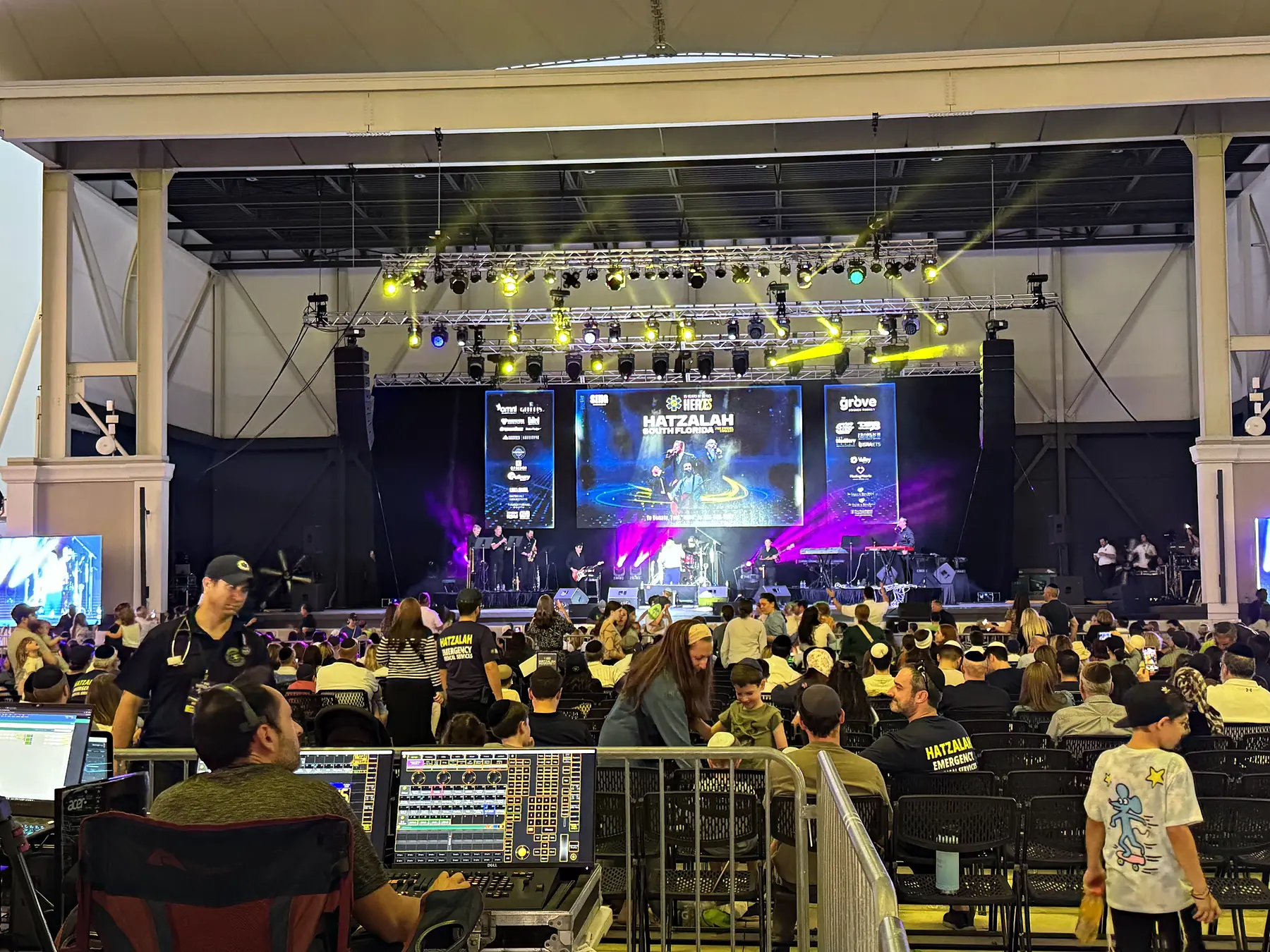
A motor lifts as high as its chain is long. Nothing about that is adjustable.
Which makes the chain on the order form one of the most informative numbers on a rigging plot.
A chain hoist pulls a loop of chain through a gearbox. The chain that is not carrying load gathers in a bag underneath, and the length of that chain is a hard ceiling on how far the motor can lift. Seventy-five feet of chain on a one-ton motor is not a preference; it is a statement that the steel it hangs from is a long way up.
That changes the build rather than just the shopping list. In a ballroom with a twenty-foot ceiling, a lighting rig trims out not far above head height and can be reached from a lift for the rest of the day. At arena trim it cannot: once it is up, anything that was not finished on the floor stays unfinished, or the whole hang comes back down.
So the discipline tightens in proportion to the height. Every fixture addressed, every cable dressed, every safety on, every focus roughed in — all of it before the first motor takes weight. A build that trims at seventy feet gets one attempt in practical terms, and the hour before the lift is the hour that decides the show.
A long array is not a louder array. It is a taller one.
Cabinet count is about how far down the room the coverage reaches evenly, which is a geometry question before it is a level one.
The instinct is that more cabinets means more volume, and it is the wrong instinct. A line array works because a column of boxes behaves as one tall source rather than as many small ones, and the useful consequence is control: a tall column can be aimed so that the back of the room and the front of the room hear something close to the same thing.
Each cabinet in the hang is angled slightly differently from the one above it. The boxes at the top are aimed long, at the furthest seats, and are worked hardest; the ones at the bottom are aimed at the nearest rows and are turned down. Adding cabinets adds reach and evenness down the length of the room, not headroom at any one seat.
Subwoofers are a separate argument that happens on the floor. Low frequencies are long — a 40 Hz wave is about 28 feet from crest to crest — and something that long does not behave like a beam, so it is placed and arrayed at ground level where its coverage can be shaped by position rather than by aim.
The confetti is the easy part. The tanks are not.
Anything that fires, falls or vents is a structural and safety item that happens to look good.
A carbon-dioxide jet is a valve on a pressurised cylinder. The cylinders are heavy, they are under pressure for the whole show, the lines that feed them cross a stage people are working on, and the gas they release is heavier than air and displaces it. None of those are reasons not to use them. All of them are reasons the position of every tank is on a drawing rather than decided at soundcheck.
Confetti has the opposite profile and its own tail: nothing about firing it is difficult, and everything about the twenty minutes after the show is. It lands on the deck, in the cable, inside the amplifier intakes and on every horizontal surface in the room, and somebody has agreed in advance whose job that is — because on a university campus the room usually has to be handed back the same night.
The honest version of both is that effects are scheduled and rehearsed like any other cue. The moment they are treated as decoration added at the end is the moment one of them fires into a truss somebody is standing on.